
-- Alan Whitfield
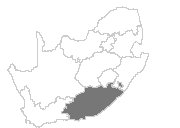 Members in this region
maintained a high degree
of involvement with
SASAQS affairs,
primarily due to the fact
that the Executive
Committee is currently
located in Grahamstown. These
activities will be outlined in the President's
Report so I will restrict my comments to a few
local news snippets from members at the Albany
Museum, Rhodes University's Zoology
Department and the J.L.B. Smith Institute of
Ichthyology.
Members in this region
maintained a high degree
of involvement with
SASAQS affairs,
primarily due to the fact
that the Executive
Committee is currently
located in Grahamstown. These
activities will be outlined in the President's
Report so I will restrict my comments to a few
local news snippets from members at the Albany
Museum, Rhodes University's Zoology
Department and the J.L.B. Smith Institute of
Ichthyology.
On the freshwater side, Total(SA) have partially sponsored a poster on the Albany Museum's Save the Eastern Cape Rocky Project. The poster depicts more than 40 animals which live in the Blaaukrantz Nature on the Kowie River. Maggie Newman, the artist, did an excellent job combining both terrestrial and aquatic environments and their inhabitants, from the small aquatic invertebrates to a majestic leopard. Dr Jim Cambray, who runs the project at the museum, asked the artist to include a leopard in the painting in memory of the one that was shot in the region last year. The "stars" of the poster are the endangered fish species, the Eastern Cape Rocky (Sandelia bainsii), which occurs in the Kowie River. The poster is intended to be an artwork as well as informative. The posters are available from the Albany Museum at R10 which includes a brochure. Part of this money will go towards the conservation of the many species still remaining along and in the Kowie River.
Still on the threatened fishes theme, several Eastern Cape members of SASAQS featured in the Estuaries Pipefish (Syngnathus watermeyeri) story on TV. This endemic estuarine fish species was thought to have become extinct in recent decades but was "rediscovered" in the East Kleinemonde Estuary. The 50/50 TV programme on this event was broadcast in May 1997 and elicited a strong response from the public.
On the marine side, an important event for some of our marine members at the Department of Zoology (Rhodes University) was a highly successful research cruise to Marion Island. The objective was to carry out a large scale sampling grid around the Prince Edward Islands evaluating the distribution of zooplankton and micronekton in the context of the position of the Subantarctic Front as this is believed to have major implications for food availability for the land-based predators, especially the penguins. The physical conditions around the island were very different from previous years. In particular rainfall has decreased dramatically over the last few years. High phytoplankton productivity over the island shelf is thought to be related to fresh water runoff from the islands which is often associated with plankton blooms. There was no such bloom this year, perhaps because of reduced run off. Community structure in the zooplankton differed markedly from last year and arrow worms, or chaetognaths, an important component of the predator guild, were especially rare.